Showing posts with label L. Show all posts

Saturday, 19 January 2013

Laïc, laïque (lay brother, lay sister)

A member of a religious community, but not clergy.
The lay brothers and sisters are mainly occupied with domestic chores.
The picture refers to the spot where the building for the lay brothers of the abbaye (abbey) of Cluny once stood.
See also convers, converse (synonym).


La Malgouverne - Cluny

Lambris (ceiling panelling ©)

The translation in the title is followed by this sign ©; this means that it has been "invented" by me.

Wooden panelling of voûtes (vaults) or plafonds (ceilings).
In this picture of the farinier of the abbaye (abbey) of Cluny the lambris is visible in the background, fixed to the roof frames.
Contrary to the lambris in this picture, it can also consist of richly decorated planks, certainly in later ages (like in the Hospice in Beaune).


Farinier - Cluny

Lancette (lancet opening)

A high, narrow baie (opening), adorned by an arc ogival (pointed arch).

The pointed arch has three shapes (see picture from Wikipedia):
 1. lancet arch (arc brisé en lancette)
2. equilateral pointed arch (arc brisé en tiers-point)
3. lowered pointed arc

In case of a lancet arch the centre of both arcs lies outside the lancet arch.
The equilateral pointed arch is an arch based on an equilateral triangle; the centres of the arcs with radii R1 and R2 are M1 and M2.
See also arc ogival and arc brisé.


Lancette - Wikipedia

Lanterne (roof lantern)

A more or less open tower-like structure, providing the space below it with daylight.
A roof lantern is often located above the croisée (crossing) of a church.
The lantern in the picture is the octagonal slightly lighter coloured structure on top of the cathédrale (cathedral) of Ely.
See also tour-lanterne (synonym).


Ely Cathedral

Larmier (hood mould)

A slightly protruding and sloping edge (e.g. a roof edge) which prevents rainwater running down a wall.
This larmier protects the wall of the chapelle orientée (transept chapel) of the Saint-Germain-d'Auxerre in Buxy.


Saint-Germain-d'Auxerre - Buxy

Lauze (flagstone)

Laves, as they are called in Burgundy, or lauzes, as they are called elsewhere, are flat stones of shale or limestone, used as floor or roofing tiles.
The roofing of the chevet of the Notre-Dame in Chazelle (Cormatin) consists of lauzes.
See also lave (synonym).


Notre-Dame - Chazelle (Cormatin)

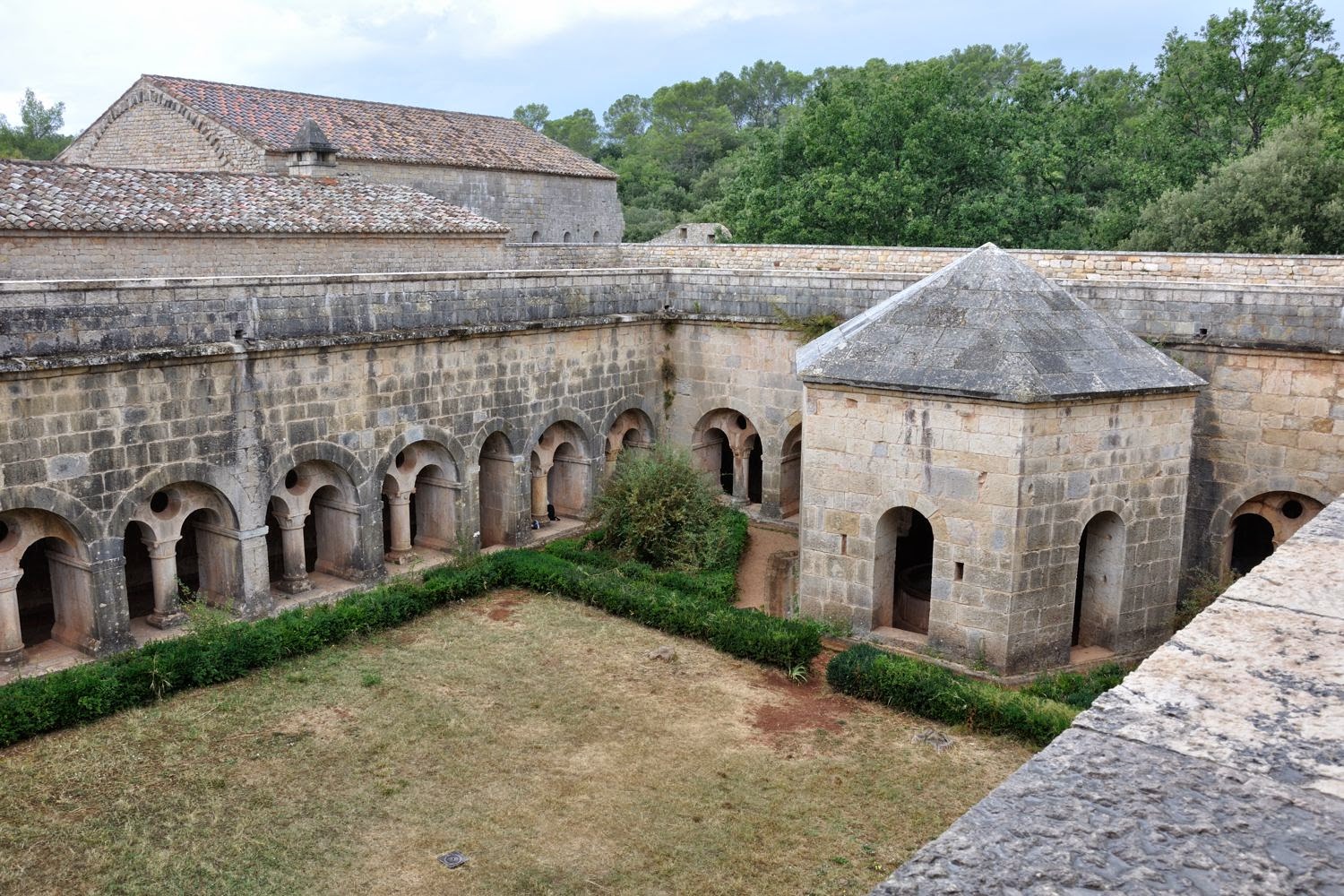
Lavabo (lavabo)

A covered washbasin in the open air, specifically in a cloître (cloister) of a monastère (monastery), where the monks washed themselves.
In the picture the lavabo in the cloître of the abbaye (abbey) Le Thoronet (Var 83).

Le Thoronet (83)
Le Thoronet (83)

Lave (flagstone)

Laves, as they are called in Burgundy, or lauzes, as they are called elsewhere, are flat stones of shale or limestone, used as floor or roofing tiles.
The roofing of the chevet of the Notre-Dame in Chazelle (Cormatin) consists of laves.
See also lauze (synonym).


Notre-Dame - Chazelle (Cormatin)

Lésène (lesene)

A lésène is a vertical, slightly protruding strip, like a pilastre (pilaster) but without base or chapiteau (capital).
In this photo of the clocher (bell tower) of the Saint-Martin in Chapaize the lésènes are easy to spot.
They are connected at the top by bandes lombardes (Lombard bands).


Saint-Martin - Chapaize

Linteau (lintel)

A lintel is a beam above a baie (wall opening), distributing the load of the wall above it to the jambages (posts).
In the context of this lexicon lintels are normally made of stone, sometimes decorated and supporting a tympan (tympanum) as well.
The lintel and tympanum in the picture are adorning the entrance to the Sainte-Marie-Madeleine in Neuilly-en-Donjon (03).


Sainte-Marie-Madeleine - Neuilly-en-Donjon

Lobe (foil)

A decorative segment of a circle, used as decoration of an arc (arch).
The picture shows an arc trilobé (trefoil arch) in the wall of 2 Place Notre-Dame in Cluny.
See also arc polylobé.


2 Place Notre-Dame - Cluny