 |
| Saiint-Philibert - Tournus |
Showing posts with label Monastère. Show all posts
Showing posts with label Monastère. Show all posts
Thursday, 31 January 2013
Abbatiale (abbey church)
A church belonging to an abbaye (abbey); on the photo the abbatiale Saint-Philibert in Tournus.

Abbaye (abbey)
An abbey is a monastère (monastery) for monks or nuns of a contemplative monastic order (e.g. the bénédictins, the Order of Saint-Benedict).
Within the walls of an abbey one would find the abbatiale (abbey church), sleeping and eating facilities, library, a vegetable garden, etc.
The plan (Wikipedia) is that of the Benedictine abbey in Cluny according to Viollet-le-Duc.
Although this abbey has been demolished it has had a major influence on roman (Romanesque) architecture.
Within the walls of an abbey one would find the abbatiale (abbey church), sleeping and eating facilities, library, a vegetable garden, etc.
The plan (Wikipedia) is that of the Benedictine abbey in Cluny according to Viollet-le-Duc.
Although this abbey has been demolished it has had a major influence on roman (Romanesque) architecture.
 |
| Cluny - Wikipedia |
Abbé (abbot)
The head of an abbaye (abbey) for monks. Cluny has seen some great abbots in its time, of which some were canonized.
In the picture the grave of Saint-Mayeul and Saint-Odilon, both abbots of Cluny in the 10th and 11th century.
The grave is located in the former clunisien (Cluniac) priorale (priory church) in Souvigny (03).
In the picture the grave of Saint-Mayeul and Saint-Odilon, both abbots of Cluny in the 10th and 11th century.
The grave is located in the former clunisien (Cluniac) priorale (priory church) in Souvigny (03).
 |
| Église Saint Pierre et Saint Paul - Souvigny |
Abbesse (abbess)
The head of an abbaye (abbey) for moniales (nuns).
This picture (Wikipedia) comes originally from a 19th century Swedish encyclopedia.
This picture (Wikipedia) comes originally from a 19th century Swedish encyclopedia.
 |
| Abbesse - Wikipedia |
Wednesday, 30 January 2013
Bénédictins (Benedictines)
Monastic order established in 529 by Saint-Benedict.
The Benedictine monks are also referred to as black monks because of the colour of their habit.
The abbaye (abbey) of Cluny was a Benedictine abbey, and the clunisien (Cluniac) Order hence a Benedictine Order.
In the picture (Wikipedia) a medal of the Benedictine Order.
The Benedictine monks are also referred to as black monks because of the colour of their habit.
The abbaye (abbey) of Cluny was a Benedictine abbey, and the clunisien (Cluniac) Order hence a Benedictine Order.
In the picture (Wikipedia) a medal of the Benedictine Order.
 |
| Bénédictins - Wikipedia |
Tuesday, 29 January 2013
Cellier (warehouse)
The space used to store food and materials for an abbaye (abbey).
The picture shows the interior of the cellier of the abbey of Tournus; this space is nowadays used for holding exhibitions and giving concerts.
The picture shows the interior of the cellier of the abbey of Tournus; this space is nowadays used for holding exhibitions and giving concerts.
 |
| Cellier de l'abbaye Saint-Philibert - Tournus |
Chauffoir (calefactory)
The only heated room in an abbaye (abbey).
The chauffoir or pisalis was often located next to the scriptorium.
In the photo the chauffoir of the abbey Silvacane near La Roque-d'Anthéron (Bouches-du-Rhône 13).
The chauffoir or pisalis was often located next to the scriptorium.
In the photo the chauffoir of the abbey Silvacane near La Roque-d'Anthéron (Bouches-du-Rhône 13).
 |
| Silvacane (13) |
Cistercien (Cistercians)
Monastic order founded in and named after Cîteaux.
One of the great abbots of this order was Bernard of Clairvaux.
The Cistercian monks are also referred to as white monks because of the colour of their habit.
The order follows the rules of Saint-Benedict, although strictly speaking they are not a bénédictin (Benedictine) Order.
Sobriety and simplicity are characteristic for Cistercian monastères (monasteries), and most monasteries of this order have a similar lay-out.
The coat of arms comes from Wikipedia.
One of the great abbots of this order was Bernard of Clairvaux.
The Cistercian monks are also referred to as white monks because of the colour of their habit.
The order follows the rules of Saint-Benedict, although strictly speaking they are not a bénédictin (Benedictine) Order.
Sobriety and simplicity are characteristic for Cistercian monastères (monasteries), and most monasteries of this order have a similar lay-out.
The coat of arms comes from Wikipedia.
 |
| The coat of arms of the Order - Wikipedia |
Cloître (cloister)
Square open space surrounded by four arcades.
The arcs (arches) of the arcades give a good view on the garden or courtyard in the middle.
A beautiful cloister can be found in the cistercien (Cistercien) abbaye (abbey) of Fontenay.
The arcs (arches) of the arcades give a good view on the garden or courtyard in the middle.
A beautiful cloister can be found in the cistercien (Cistercien) abbaye (abbey) of Fontenay.
 |
| Cloître - Fontenay |
Clunisien (Cluniac)
Reference to churches and buildings built in commission and under the influence of the Cluniac monastic order.
The Cluniac churches are typified by their richness of ornamentation.
The Cluniac churches are typified by their richness of ornamentation.
 |
| Site Clunisien Saint-Hippolyte (Bonnay) |
Monday, 28 January 2013
Convers, converse (lay brother, lay sister)
A member of a religious community, but not clergy.
The lay brothers and sisters are mainly occupied with domestic chores.
The picture refers to the spot where the building for the lay brothers of the abbaye (abbey) of Cluny once stood.
See also laïc, laïque (synonym).
The lay brothers and sisters are mainly occupied with domestic chores.
The picture refers to the spot where the building for the lay brothers of the abbaye (abbey) of Cluny once stood.
See also laïc, laïque (synonym).
 |
| La Malgouverne - Cluny |
Cuisines (kitchens)
Part of the abbaye (abbey) where the food is prepared.
The kitchens are, like the chauffoir (calefactory) often located next to the réfectoire (refactory).
The plan (from the internet) shows a typical lay-out of a cistercien (Cistercian) abbey.
The kitchens are, like the chauffoir (calefactory) often located next to the réfectoire (refactory).
The plan (from the internet) shows a typical lay-out of a cistercien (Cistercian) abbey.
 |
| Abbaye cistercien - Wikipedia |
Sunday, 27 January 2013
Dortoir des convers (dormitory of the lay brothers)
Big dormatory on the first floor of the building of the convers or laïcs (lay brothers or sisters) of an abbaye (abbey), often divided in two by a row of piliers (pillars).
In the picture the remains of the building of the convers of Cluny abbey.
In the picture the remains of the building of the convers of Cluny abbey.
 |
| La Malgouverne - Cluny |
Dortoir des moines (dormitory of the monks)
Big dormatory on the first floor of the building of the moines (monks) of an abbaye (abbey), where the monks were sleeping side by side.
In the picture the dormitory of the monks in the abbey of Fontenay.
In the picture the dormitory of the monks in the abbey of Fontenay.
 |
| L'Abbaye de Fontenay |
Doyenné (deanery)
In the Roman Catholic Church a doyenné consists of a number of parishes; it is the organizational layer between the diocèse (diocese) and those parishes.
The head of a doyenné is a curé-doyen (dean).
Doyenné has also a second meaning: it is an agricultural unit providing an abbaye (abbey) or a prieuré (priory) with agricultural products. The person in charge is also called doyen (dean).
In the picture the tower and on the left the beginning of the defence walls; the building on the right is the logis (housing) of a doyenné in the second sense.
The doyenné was accessible via a drawbridge in front of the tower, and within the walls stood a chapelle (chapel).
It is de doyenné of Bezornay (Saint-Vincent-des-Prés).
The head of a doyenné is a curé-doyen (dean).
Doyenné has also a second meaning: it is an agricultural unit providing an abbaye (abbey) or a prieuré (priory) with agricultural products. The person in charge is also called doyen (dean).
In the picture the tower and on the left the beginning of the defence walls; the building on the right is the logis (housing) of a doyenné in the second sense.
The doyenné was accessible via a drawbridge in front of the tower, and within the walls stood a chapelle (chapel).
It is de doyenné of Bezornay (Saint-Vincent-des-Prés).
 |
| Doyenné de Bezornay (Saint-Vincent-des-Prés) |
Thursday, 24 January 2013
Grandmontains (Grandmontines)
A monastic order founded in the Limousin around 1076.
The first picture shows the remains of the Grandmontine pirory in La Grange-du-Bois; below that one (from their own website) a plan of one of their monastères (monasteries).
The first picture shows the remains of the Grandmontine pirory in La Grange-du-Bois; below that one (from their own website) a plan of one of their monastères (monasteries).
 |
| La Grange-du-Bois |
 |
| Monastère grandmontain - internet |
Tuesday, 22 January 2013
Infirmerie (infirmary)
The infirmary in a monastère (monastery).
The picture shows a ward in the hospital that belonged to the monastery of Canterbury.
The picture shows a ward in the hospital that belonged to the monastery of Canterbury.
 |
| Hospital of Saint-Thomas - Canterbury |
Saturday, 19 January 2013
Laïc, laïque (lay brother, lay sister)
A member of a religious community, but not clergy.
The lay brothers and sisters are mainly occupied with domestic chores.
The picture refers to the spot where the building for the lay brothers of the abbaye (abbey) of Cluny once stood.
See also convers, converse (synonym).
The lay brothers and sisters are mainly occupied with domestic chores.
The picture refers to the spot where the building for the lay brothers of the abbaye (abbey) of Cluny once stood.
See also convers, converse (synonym).
|
| La Malgouverne - Cluny |
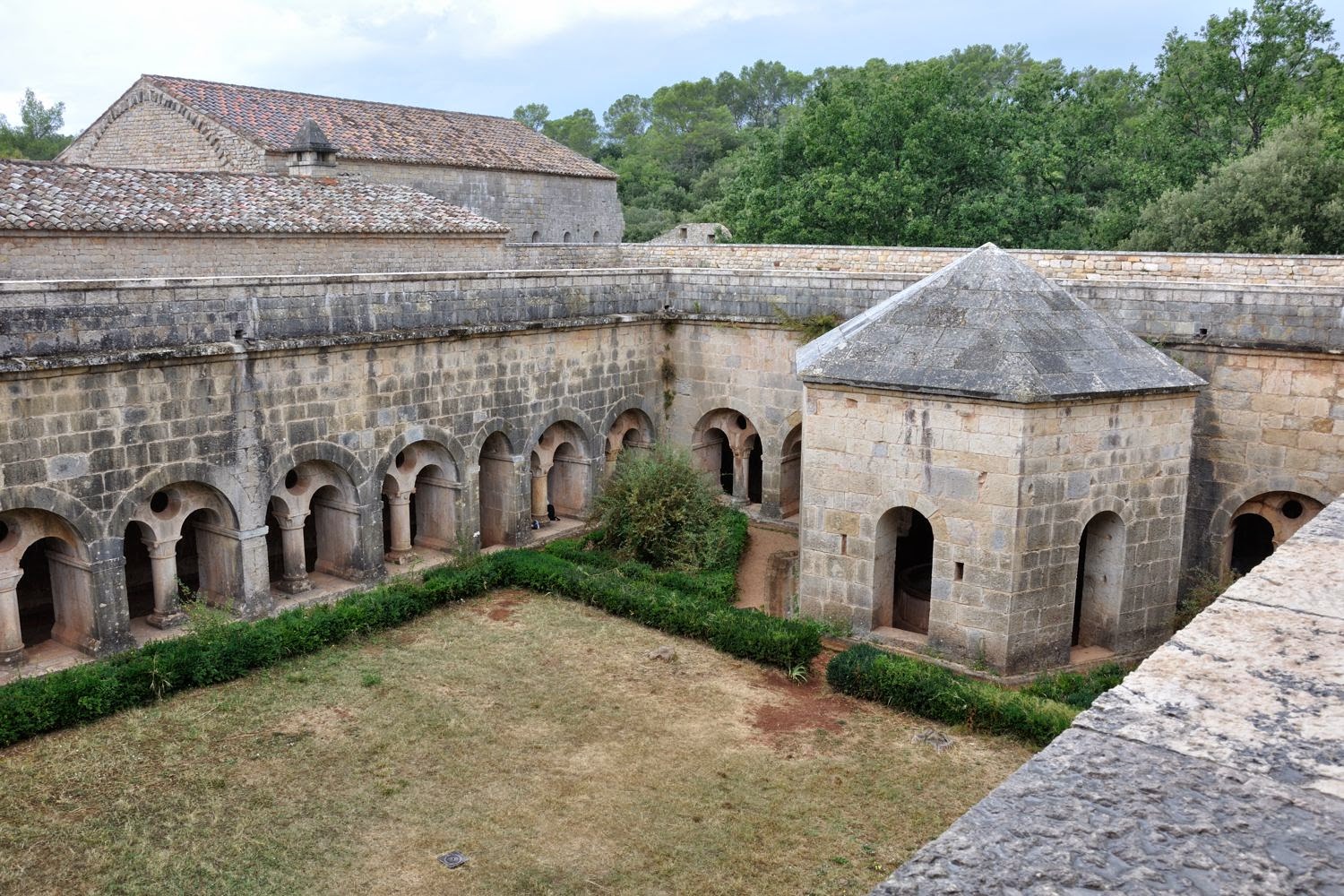
Lavabo (lavabo)
A covered washbasin in the open air, specifically in a cloître (cloister) of a monastère (monastery), where the monks washed themselves.
In the picture the lavabo in the cloître of the abbaye (abbey) Le Thoronet (Var 83).
In the picture the lavabo in the cloître of the abbaye (abbey) Le Thoronet (Var 83).
 |
| Le Thoronet (83) |
 |
| Le Thoronet (83) |
Friday, 18 January 2013
Monastère (monastery)
A complex of buildings in which a religious community lives and works.
The picture shows the plaquette at the entrance of the monastery of Fontenay.
The picture shows the plaquette at the entrance of the monastery of Fontenay.
 |
| L'abbaye de Fontenay |
Subscribe to:
Posts (Atom)


