Showing posts with label R. Show all posts

Sunday, 13 January 2013

Rampant (slanting plane)

Part of a building (or a decoration) that slopes.
The clocher (bell tower) of the Saint-Pierre in Brancion (Martailly-lès-Brancion) is square, the croisée (crossing) underneath it is barlong (rectangular).
The picture shows this clearly.
The sloping parts of the roof left and right at the bottom of the bell tower, accommodating the transformation from square to barlong, are rampants.


Saint-Pierre - Brancion (Martailly-lès-Brancion)

Réfectoire des convers (refectory of the lay brothers)

The refectory is a dining room of an abbaye (abbey), in this case the room where the lay brothers or sisters eat.
This room is normally located at ground level in the building where the lay brothers or sisters live.
The picture refers to the place where the building of the convers (lay brothers) of Cluny abbey once stood.


La Malgouverne - Cluny

Réfectoire des moines (refectory of the monks)

The refectory is a dining room of an abbaye (abbey), in this case the room where the monks or nuns eat.
This room is normally located at the south side of the cloître (cloister).
The picture shows the réfectoire des moines of the abbey of Tournus.


L'abbaye - Tournus

Registre (register ©)

The translation in the title is followed by this sign ©; this means that it has been "invented" by me.

A decorative band, either painted or sculptured.
The tympan (tympanum) of the Saint-Vincent in Mâcon has five registres.


Saint-Vincent - Mâcon

Reliquaire (reliquary)

An often richly decorated container holding the remains of a saint.
The whole or almost the whole corpse of a saint is normally stored in a châsse (chasse).
Small singular parts (heart, nails) are normally kept in a smaller container, the reliquaire.
The box in the picture contains the remains of Saint-Philibert (Saint-Philibert in Tournus).


Saint-Philibert - Tournus

Relique (relic)

Part of a body of a saint (a nail, the heart, a bone), or something that belonged to a saint (e.g. a shroud).
In the picture the remains (bones, pieces of flesh) of various Saints (amongst others Saint-Martin) in the Saint-Martin in Cressy-sur-Somme.

Relique - Cressy-sur-Somme

Réemploi (recycling)

The recycling of construction parts which originally were part of an older building.
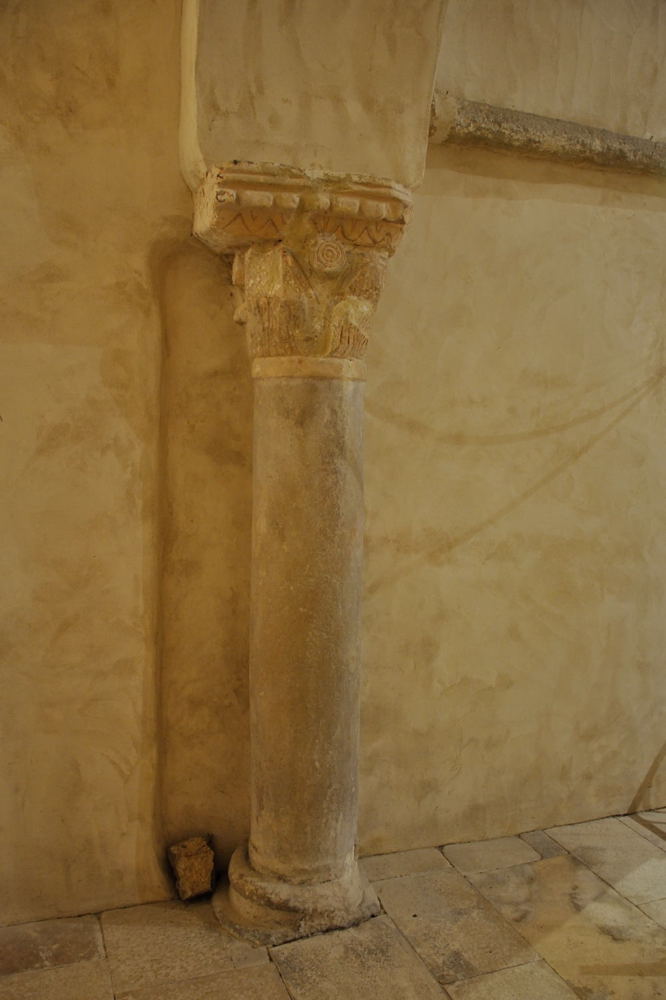
The chapiteau (capital) in the picture taken in the Saint-Quentin in Bray most likely originally came from an older church, and hence has been recycled.


Saint-Quentin - Bray

Renaissance (Renaissance)

Style and style period following the gotique (Gothic) period.
Renaissance means literally rebirth and it falls back on classic antiquity. The Renaissance began in Florence (Italy) in the 14th century.
The picture shows the beautiful Renaissance town hall in Paray-le-Monial.


Hôtel de ville - Paray-le-Monial

Rinceau (winding plants motif ©)

The translation in the title is followed by this sign ©; this means that it has been "invented" by me.

An arabesque of floral and botanical motifs, like flower stems or branches with leaves, winding around each other.
The picture shows rinceaux on the piédroits (posts) of the portail (portal) of the abbaye (abbey) in Charlieu (42).


L'abbaye - Charlieu

Roman (Romanesque)

Term conceived in 1818 by the Frenchman Charles de Gerville for the architectural style which developed in Europe in the 11th and 12th century.
This lexicon is dedicated to (mainly) Romanesque architecture.
The picture shows a plaquette of the "Centre International d'Études Romanes" in Tournus.


Centre International d'Études Romanes - Tournus

Ronde-bosse (ronde-bosse)

This term is used to stress the contrast with 2D representations, such as the depictions on a tympan (tympanum); these can only be admired when one stands in front of them.
A work of art executed in ronde-bosse allows the spectator to walk around it and admire all facets of it.
The chapiteaux (capitals) from the chœur (choir) of Cluny III, displayed in the farinier of the abbaye (abbey) of Cluny are good examples of works in ronde-bosse.


Farinier - Cluny

Rose (rose window)

A big circular window, usually placed in the highest part of the façade (facade) of a church.
This rose window can be found in the transept of the Saint-Hilaire in Semur-en-Brionnais.


Saint-Hilaire - Semur-en-Brionnais

Rotonde (rotunda)

A circular space in the heart of a church, meant to facilitate processions of big groups of pilgrims.
The picture shows the interior of the Chiesa di Santo Stefano Rotondo in Rome; the plan of Viollet le Duc (Wikipedia) underneath shows the rotunda in the crypte (crypt) of the Saint-Bénigne in Dijon.

Chiesa di Santo Stefano Rotondo - Rome

Rotonde - Wikipedia

Rouleau (stone arch ©)

The translation in the title is followed by this sign ©; this means that it has been "invented" by me.

A number of claveaux or voussoirs forming an arc (arch).

See also arc.


Rouleau - Wikipedia