Showing posts with label T. Show all posts

Friday, 11 January 2013

Tailloir (covering plate)

A square or polygonal plate covering a chapiteau (capital); the starting point of an arc (arch) or voûte (vault).
The picture shows a beautifully decorated tailloir as part of the portail (portal) of the Saint-Romain in Saint-Romain-sous-Gourdon.
See also abaque (synonym).


Saint-Romain - Saint-Romain-sous-Gourdon

Tambour (drum)

A cylindrical piece of stone; tall and big colonnes (columns) are often not hewn out of one piece of stone, but composed of a number of drums.
The picture clearly shows the drums forming the contrefort-colonne (buttress column).
Tambour also has a second meaning; it can also be the circular or polygonal wall on which a dôme (dome) rests.


Notre-Dame-de-l'Assomption - La Chapelle-sous-Brancion

Tempera (tempera)

Tempera is a painting technique that uses natural pigments mixed with egg yolk and water.
This technique was the predecessor of oil painting, and is still traditionally used in iconography.
On one of the walls in the Hospital of Saint-Thomas in Canterbury this tempera wall painting of Christ en gloire can be found.
For a layman there is hardly any difference between a tempera painting and a fresque (fresco), like the frescos in Berzé-la-Ville.
The picture shows, just outside the mandorle (mandorla) two parts of the tétramorphe (tetramorph).
See also détrempe (synonym).


Hospital of Saint-Thomas - Canterbury

Templiers (Knights Templar)

Members of the (rather military) monastic Order of the Temple. The Order was founded in 1118.
The red cross (Wikipedia) is the coat of arms of the templars.


Templiers - Wikipedia

Tétramorphe (tetramorph)

Symbolic, allegoric representation of the four evangelists.
Matthew is depicted as an angel, John as an eagle, Luke as an ox or a calf and Mark as a lion.
The tetramorph is also referred to as "les quatre vivants" (the four living creatures).
The ceiling of the chœur (choir) of the Saint-Ferréol in Curgy shows the tetramorph: left top Matthew, right top John, right bottom Luke and left bottom Marc.


Saint-Ferréol - Curgy

Tierceron (lierne)

A rib in a voûte (vault) which neither starts from a sommier (springer) nor arrives at the clef de voûte (keystone), hence an intermediate or tertiary rib.
Tiercerons are common in gothique (Gothic) and Renaissance vaults.
The picture (Wikipedia) highlights the tiercerons.


Tierceron - Wikipedia

Tiers-point (top of an equilateral triangle)

In geometry the top of a triangle with three equal sides, and hence with three angles of 60 degrees.
This rather incomprehensible picture comes from Wikipedia.
See also arc ogival.


Tiers-point - Wikipedia

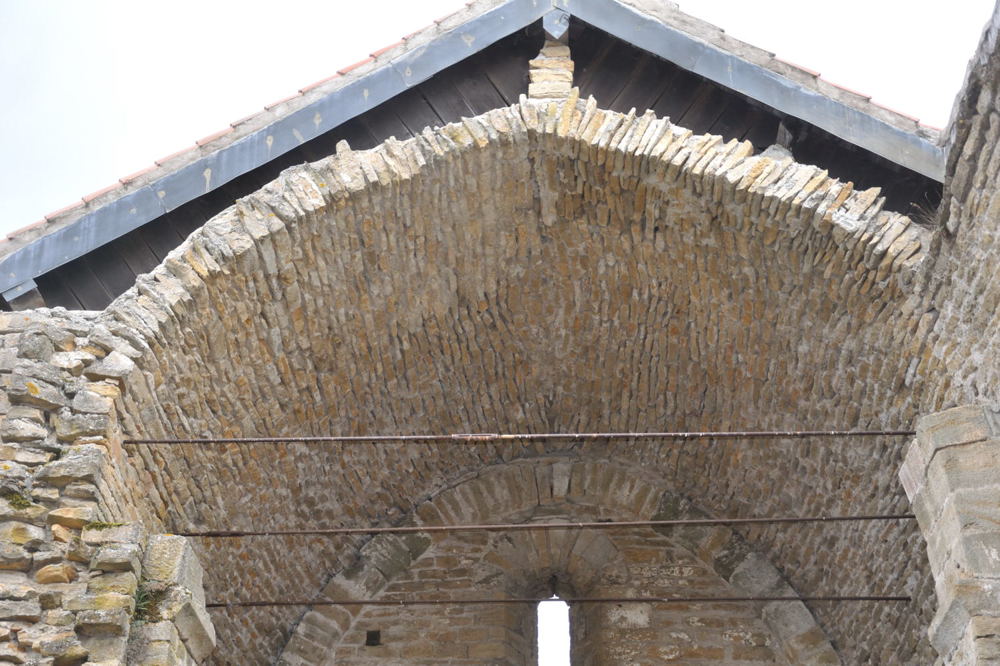
Tirant (tie bar)

Wooden or steel rod used to stabilize a crumbling construction.
The tie bars in this picture keep the walls and the voûte (vault) of the nef (nave) of the Saint-Christophe in Le Puley together.


Saint-Christophe - Le Puley

Tore (torus)

A ring at the bottom of a colonne (column), roughly the same as an astragale (astragal).
The columns are those of the déambulatoire (ambulatory) of the Notre-Dame-de-la-Nativité in Bois-Sainte-Marie.
See also boudin (synonym).


Notre-Dame-de-la-Nativité - Bois-Sainte-Marie

Tourelle (staircase tower ©)

Although Wikipedia keeps suggesting that the word actually means gun turret, and in case of fortifications just a turret, Mr. Eduard van Boxtel's glossary (letter T) claims that it is a small tower, often just housing a staircase.
I think I will stick with his explanation.
The picture shows a medieval tourelle in Saint-Gengoux-le-National.

Saint-Gengoux-le-National

Tour-Lanterne (roof lantarn)

A more or less open tower-like structure, providing the space below it with daylight.
A roof lantern is often located above the croisée (crossing) of a church.
The lantern in the picture is the octagonal slightly lighter coloured structure on top of the cathédrale (cathedral) of Ely.
See also lanterne (synonym).


Ely Cathedral

Transept (transept)

A transept is a nef transversale (transverse nave), perpendicular to the nef centrale (central nave).
It gives a church its characteristic shape of a Latin cross.
A transept consists of three parts; the overlapping part of nef (nave) and transept is called croisée (crossing) and the two parts of the transept north and south of the crossing are called the croisillons (transept arms) or bras du transept.
The clocher (bell tower) is often located above the croisée.
Generally speaking the transept separates the nave from the chœur (koor).
In plan (Wikipedia) the transept is indicated in grey.
For all parts of the transept described above see also all other entries related to transept.


Transept - Wikipedia

Transept bas (low transept)

A transept of which the height is lower than that of the nef (nave).
The low transept is characteristic for the earliest period of roman (Romanesque) architecture.
The difference in height between nave and transept is clearly visible in this picture of the Saint-Julien in Donzy-le-Pertuis.
For all parts of the transept described above see also all other entries related to transept.


Saint-Julien - Donzy-le-Pertuis

Transept, bras du (transept arm)

A bras du transept is one of the arms of the transept.
In plan (Wikipedia) the bras du transept are the two parts of the transept north and south of the croisée (crossing).
The picture shows a view on crossing and southern transept arm, taken from the northern transept arm of the Saint-Roch in Passy.
see also transept, croisillon du (synonym).
For all parts of the transept described above see also all other entries related to transept.


Bras du transept - Wikipedia

Saint-Roch - Passy

Transept, carré du (crossing)

The crossing is the central part of a church.
It is the overlapping area of the nef principale (central nave) and the transept.
The crossing is often covered with a coupole (cupola), which in itself forms the base of a clocher (bell tower).
The picture comes from Wikipedia; the crossing is indicated in grey.
See also transept, croisée du (synonym).
For all parts of the transept described above see also all other entries related to transept.


Carré du transept - Wikipedia

Transept, croisée du (crossing)

The crossing is the central part of a church.
It is the overlapping area of the nef principale (central nave) and the transept.
The crossing is often covered with a coupole (cupola), which in itself forms the base of a clocher (bell tower).
The picture comes from Wikipedia; the crossing is indicated in grey.
See also transept, carré du (synonym).
For all parts of the transept described above see also all other entries related to transept.


Croisée du transept - Wikipedia

Transept, croisée régulière du (regular crossing ©)

The translation in the title is followed by this sign ©; this means that it has been "invented" by me.

A crossing where the heights of the nef (nave), the croisillons (arms of the transept) and the chœur (choir) are identical.
This is typical for clunisien (Cluniac) churches.
In the picture : behind the crossing lies the choir, in front of it the (modern) nave, on the left and right hand side the transept arms.

For all parts of the transept described above see also all other entries related to transept.


Saint-Bonnet - Saint-Bonet de Cray

Transept, croisillon du (transept arm)

A croisillon is one of the arms of the transept.
In plan (Wikipedia) the croisillons are the two parts of the transept north and south of the croisée (crossing).
The picture shows a view on crossing and southern transept arm, taken from the northern transept arm of the Saint-Roch in Passy.
see also transept, bras du (synonym).
For all parts of the transept described above see also all other entries related to transept.


transept - Wikipedia

Saint-Roch - Passy

Transition (transitional style)

A style that marked the end of the roman (Romanesque) and the beginning of the gotique (Gothic) period, and that contained characteristics of both styles.
An example of this style is the Saint-Albain in Saint-Albain.


Saint-Albain - Saint-Albain

Travée (bay)

In plan (Wikipedia) a bay (in grey) is defined by four colonnes (columns).
When speaking of the travée of a voûte (vault), the travée shifts half a bay; it is that part of a vault that is supported by two columns and an arc-doubleau (belt arch).


Travée - Wikipedia